Thank you! Your submission has been received!
Oops! Something went wrong while submitting the form.
.png)
In real life, marketers don’t need another magical AI platform promising to “revolutionise your workflow” with a rainbow button and a unicorn mascot. We’ve all bought those tools, and they sit in your tech stack like that streaming service you forgot to cancel three years ago. The real upgrade isn’t software. It’s the unglamorous stuff: standardizing briefs so they don’t read like mystery novels, building a shared library so winners don’t disappear into the Bermuda Triangle of someone’s desktop, and letting AI flag weak briefs before your creative team stages a mutiny.
Once agents start handling the boring repetitive and routine work, your humans finally get to do human things like judgment, taste, strategy. It’s not sorcery. It’s just starting the race 20 meters/22 yards ahead instead of waking up at the starting line with one shoe missing.
If you want proof that this shift is real, look at the latest research. McKinsey just dropped their 2025 State of AI report. Translation for marketers: AI is no longer a just way to improve your personal productivity. AI is now the difference between teams producing high-performing creative and teams producing ‘fine, I guess’ work under pressure.
The takeaways from the report are pretty blunt. Almost 9/10 organisations are now using AI somewhere in the business, yet only about 1/3 have managed to scale it, and only a small group of high performers are seeing serious impact because they have redesigned workflows around AI instead of sprinkling tools on top of the way we’ve always done it.
Here is the awkward part: most marketers are still clinging to workflows built for the PowerPoint era, or perhaps the calculator era. A brief goes to an agency, sits in a queue, comes back as a big beautiful deck, goes into three rounds of comments, then finally limps into production long after the campaign theme may have already become irrelevant. Add AI image generation from Nano Banana and video generation from Veo 3 into that pipeline and all you’ve done is learn how to create the wrong stuff faster.
{Note: We can help your marketing and advertising teams move from old school to new school in just days. Please email or DM me here if you'd like to hear more}
The McKinsey high performers look different. They use AI to drive growth and innovation, and they are almost 3X more likely to have fundamentally redesigned workflows. So what does that actually look like when you are a marketing director with a launch next month and a media plan already booked?
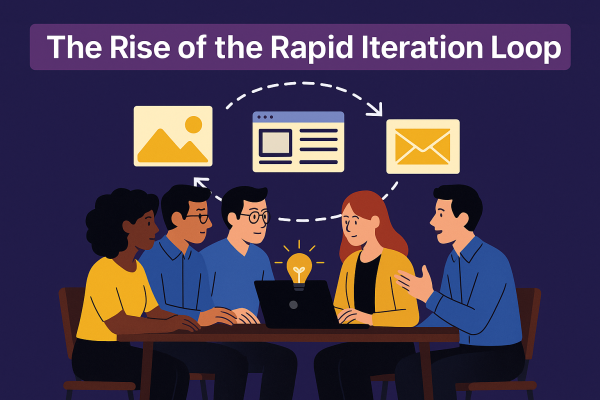
Start with campaign development and the dreadfully slow approval chain. In a traditional campaign, strategy writes a brief, creative disappears, media waits, and leadership sees the work once everything is locked. I’ve been in “quick review meetings” where 4 people and 8 listening devices show up, nobody has read the brief except MS Teams, and somehow the only thing we decide after 90 minutes is that we need another meeting. By the end, I’m ready to iterate myself out of a moving car.
A rapid iteration loop flips that completely. Imagine a small “war room” for a single campaign. Your brand lead, performance marketer and one creator sit in the same room - live or virtual - with an AI assistant. In the first two hours, they generate twenty versions of the core message, five visual directions and three landing page angles. By the afternoon, the strongest ideas go-live in tiny, low risk tests, a small paid social budget, an email split test, a couple of headlines rotated on a landing page. By mid week you have data, not opinions, and the next wave of creative is already using those signals.
In this world, the big scary approval moment gets replaced by a set of clear guardrails.
Within those boundaries the team is free to test, learn and ship at a speed that would make your old quarterly campaign calendar weep in shame, metaphorically of course. AI is the engine inside those loops, not a shiny add on. It drafts copy, generates visuals, summarises performance, and suggests the next experiment while your humans focus on judgment and creativity and direction.

Now look at your creative output. Most marketing and advertising folks remain secretly in love with the One Hero Asset, and this drives me crazy. I’ll be watching a football game and the same beer commercial comes up 15 times in 3 variations - 20 seconds, 30 seconds, and 45 seconds. After seeing this 500 times, I want to switch to wine.
One perfect TV spot. One hero visual. One flagship film or photo shoot that is meant to carry the whole weight of the campaign. Everything else is a cut down, a resize or a forced adaptation for a channel it was never designed for.
{Note: We can help your marketing and advertising teams move from old school to new school in just days. Please email or DM me here if you'd like to hear more}
Generative AI breaks that logic. The expensive part used to be production. Today the scarce thing is not production capacity, it is your ability to decide which ideas are worth testing. You do not need one masterpiece. You need a coherent idea that can be expressed in many ways.
So instead of sweating over a single flawless video, you start with a simple structure. Here is the core promise. Here are four possible emotional hooks. Here are three objections your buyer always has. Here are two proof points that matter in each segment. AI becomes your variant factory. It helps you spin those ingredients into dozens of executions tuned for different audiences and channels. Some will fall flat. That is fine. You retire them quickly and redirect spend to what works. Over time, your “hero” is not a single asset pinned on a wall. It is a live, evolving system of messages and visuals that keeps learning.
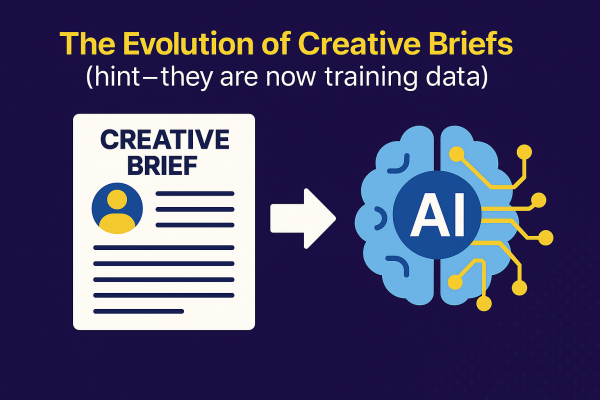
The third shift is the least glamorous and probably the most powerful. Treat your creative briefs as training data, not just Word documents that vanish into the abyss. In most marketing departments, every brief is reinvented from scratch. Someone writes a page of prose about the target audience, the problem and the deliverables, sends it off, and the only time it is seen again is when someone scrolls back through email looking for blame. We call that ‘CYA’.
You know what briefs look like: “Make it catchy, on-brand, localised, high-conversion, emotional, timeless and measurable.” That’s not a brief. That’s a cry for help!
If you want AI to be genuinely useful, that same information has to become structured and reusable. Instead of “busy professionals who care about convenience”, you store a persona with attributes. Instead of a vague line about “increasing awareness”, you capture the specific behaviour you want: sign ups, demo requests, subscriptions, repeat bookings. You log which offer was used, which proof points were included, what tone was chosen, and how the assets performed.
Over a few campaigns you are no longer sitting on a random pile of decks. You are sitting on a marketing knowledge base that AI can learn from. When you brief your team for new creative, you do not say “write me a LinkedIn post about our product”. You say “based on our past high performing campaigns for mid market CFOs worried about cloud costs, propose three new angles for Q1 and draft copy for paid social and email”. The system can actually answer that because you have been feeding it with structured briefs and tagged results, not scattered attachments.
In Closing
The solution isn’t some enchanted AI platform with sparkles and promises. It’s the subtle but powerful upgrade to how your team operates each day using AI
Then start letting agents handle the boring part of execution. Let them read the brief, pull old winners and suggest first pass assets for each channel. Your humans still decide what is on brand, what is clever and what is creative vanity. They just start twenty meters ahead of the starting line.
McKinsey’s message between the lines is simple. Everyone has AI now. The advantage sits with the teams who redesign how work gets done. For marketers, that means shorter loops, more variants and smarter briefs. Not more decks.
{Note: We can help your marketing and advertising teams move from old school to new school in just days. Please email or DM me here if you'd like to hear more}

Sausalito AI helps organizations build an actionable AI implementation plan in under three days. We also upskill your teams, providing training on AI tools and Microsoft Copilot, creating measurable results almost instantly. With a proven track record of success, in 2025 alone Sausalito AI helped over 3,000 people advance their AI strategy and skills.
.svg)


.svg)