Thank you! Your submission has been received!
Oops! Something went wrong while submitting the form.
.png)
Part 3 of a 5-Part Series on how success in AI is determined by the Rapid Iteration Loop — across Marketing, Supply Chain, Finance, Sales, and HR & Culture.
Let's start with a number that should bother you. According to McKinsey, 85% of office employees are using AI in their work. Our own client surveys put that closer to 91%. And yet only 30% of organizations are seeing any measurable value from it. Even worse, the club of true high achievers sits at just 6%, and only 1% have a fully-baked AI implementation strategy.
So what separates the 30% from the 6%?
The high performers aren't hanging neon lights in a condemned building. They are bulldozing the lot and pouring a new foundation.
Nowhere is that distinction more visible or more consequential than in Finance.
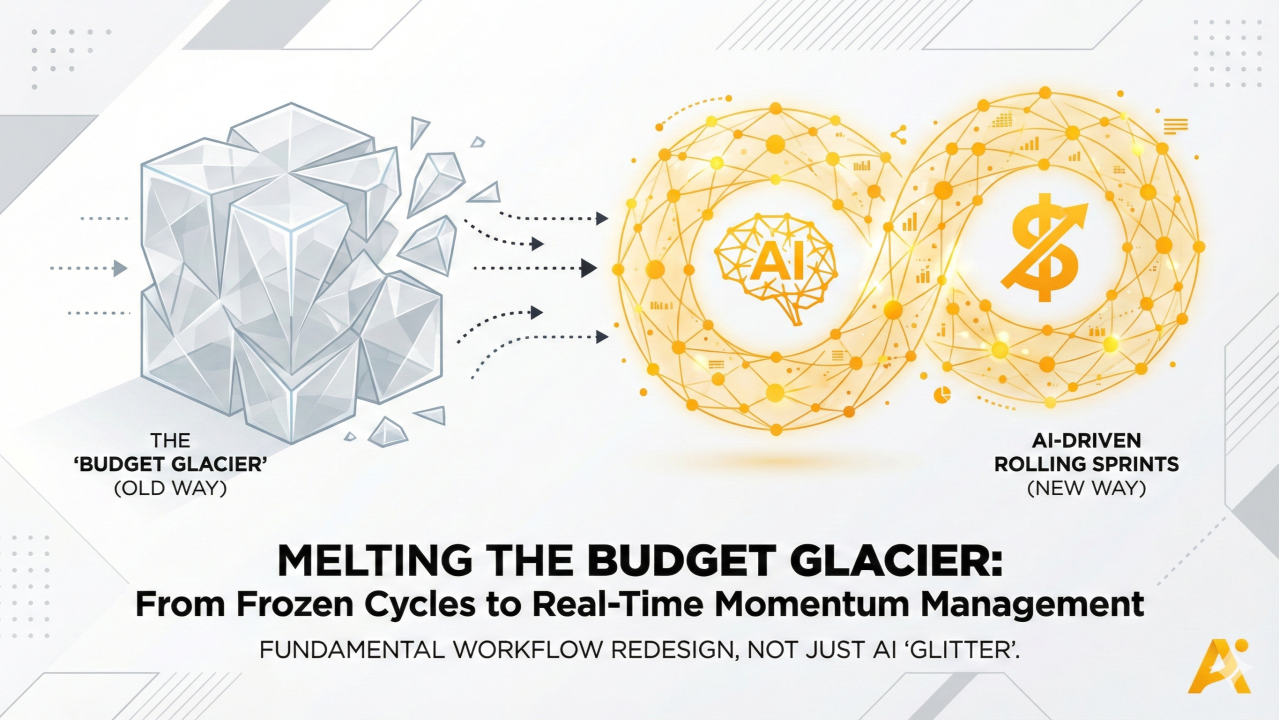
Here's how most Finance departments operate. At some point before the fiscal year begins, a budget gets frozen. Approved. Locked. And from that moment on, it starts aging like milk left on a New York City sidewalk in July.
By July, the world has moved on. Competitors have pivoted. Markets have shifted. A new technology has disrupted an entire category. But inside the building, everyone is still chipping away at that original budget with spoons, bound by assumptions that were already questionable when they were made. Requesting a reallocation mid-year? That requires a ritual sacrifice, a 47-slide deck, and a two-week approval chain.
I call this the Glacier Model. It once made sense. It no longer does.
The old way is the Annual Plan, a document that is obsolete the moment it is approved. (Nobody says this out loud at the budget presentation, but everyone in the room knows that it is true.)
The Rapid Iteration Loop replaces Annual Planning with Rolling Sprints. Finance stops being the department that tells you what you spent and becomes what I like to call the War Room, or the Peace Room, if you prefer less aggression in your metaphors.
Here's how it works in practice. Instead of waiting for the end-of-quarter autopsy to discover you've been pouring money into the wrong bucket for three months, the loop catches the misalignment inside of a week. AI analyzes real-time spend versus performance across every department, flags the drift, and generates five "What If" reallocation scenarios before lunch. You test the most conservative one by Tuesday. By Friday, the capital has moved toward where the growth is, and away from where the waste is quietly leaking.
That's not accounting. That's momentum management.
Now let's talk about pricing, because this is where I see companies leaving the most money on the table, often without realizing it.
Most organizations set their pricing strategy and discount tiers during that same frozen budget period I just described. They rely on Standard Price Lists and Historical Averages. The problem? Markets can move in days, if not minutes. Finance updates price floors in weeks. Sometimes months. While the pricing committee is still scheduling its next meeting, a faster competitor has already won the deal or your sales team has given away margin they didn't need to.
The result? Finance becomes the Department of No. Sales teams beg for exceptions. Finance refuses — not because they want to obstruct, but because they genuinely lack the real-time data to know whether a discount is a strategic win or a margin suicide mission. Both sides are frustrated. Nobody wins.
Years ago, Michael Lewis wrote a book about high-frequency trading that was shockingly fascinating. The premise: firms using real-time data and algorithms to make pricing decisions in milliseconds were eating everyone else's lunch. The Rapid Iteration Loop brings that same logic to your own products, but without the regulatory headaches.
Think of it as Finance becoming a real-time yield optimization desk.
Here's how the loop operates. The AI ingests what I call a tri-stream of data simultaneously: externally, it's watching competitor price shifts, inflation indices, and supply chain disruptions. Internally, it's tracking live inventory levels and Customer Acquisition Cost trends and exchange rates. And behaviorally, it's analyzing the win/loss ratios on quotes going out the door this morning. Not last quarter. This morning.
Instead of a monthly post-mortem on why margins dipped (or worse, why margins dipped and you missed your revenue target, the double-whammy nobody wants to present to the board), the AI surfaces what I call a Yield Gap on Tuesday morning. Say it notices a specific region is over-discounting despite strong demand signals. It runs ten simulations to find the 'Goldilocks' price point, the one that maximizes both volume and margin, not one at the expense of the other.
By Wednesday, updated Smart Floors are pushed directly to the sales CRM. Reps get instant approval on deals within the new parameters. No approval chain. No exceptions process. And the money that would have evaporated through slow decision-making — what I call Ghost Revenue — is captured before it disappears.
The real transformation here isn't technological. It's a shift in identity.
Finance stops being a team of historians, the people who tell you what you lost after you've already lost it, and becomes a team of navigators, telling you where to steer while there's still time to steer there. You're not balancing books anymore. You're optimizing the company's engine efficiency in real time.
The question changes from "Did we hit our margin target?" to "How much margin did we leave on the table today, and can we get it back by tomorrow?"
That's a fundamentally different business. And it's available right now.

Sausalito AI helps organizations build an actionable AI implementation plan in under three days. We also upskill your teams, providing training on AI tools and Microsoft Copilot, creating measurable results almost instantly. With a proven track record of success, in 2025 alone Sausalito AI helped over 3,000 people advance their AI strategy and skills.
.svg)


.svg)